

A red light therapy recovery corner works best when it is simple to use after training and set up for repeatable sessions with the right distance, timing, and body coverage.
Does your gym corner turn into a dumping zone right when your legs feel heavy, your shoulders are tight, and you know recovery should happen now, not later? Most home users notice results only after consistent sessions over about two to four weeks, and the difference usually comes from setup and routine more than from chasing the biggest panel. This guide shows how to carve out a recovery zone that fits a real home gym, not a showroom.
Why a Recovery Corner Works Better Than Random Use
A dedicated setup makes home red light therapy easier to repeat, and repeatable use is where most of the practical value lies. In mixed-use gyms, the biggest failure point usually is not lack of interest. It is friction: the panel is blocked by a bench, there is no safe standing distance, cords cross the walkway, or the treatment spot feels too exposed and inconvenient.
Red light therapy is a noninvasive approach that uses visible red light and often near-infrared light, with red generally acting more on surface tissues and near-infrared reaching deeper tissue layers, as explained in how red and near-infrared light work. For a recovery corner, that distinction matters because skin-focused goals can tolerate a little more distance, while muscle and joint work often benefits from closer placement.
In real home gym layouts, the best recovery corner usually is not in the center of the room. It is the dead space you already have near a wall, rack end, or storage edge where you can stand still for 10 to 20 minutes without moving equipment first. That sounds minor, but it often determines whether you use a device three to five times per week or forget it exists.
Start With Space, Not the Device
A customizable room layout is more useful than a one-size-fits-all plan, so begin with your available floor area and training flow. In a multi-purpose gym, your recovery corner should stay outside the main path between the rack, treadmill, dumbbells, and door. If you need to shuffle plates or drag a bench every session, adherence drops fast.
A practical target is a standing or seated lane that gives you enough clearance to face the panel and step back to the treatment distance your device requires. Many home-use guides place panels roughly 6 to 24 inches from the body, with the closer end often used for deeper muscle or joint targets and the farther end more common for skin-focused sessions, as described in device placement guidance and how red and near-infrared light work. If your corner cannot comfortably support that spacing, the layout is not finished yet.
Lighting, flooring, and storage matter more than people expect. A stable mat or hard floor helps you hold position. A small stool makes calf, knee, or ankle work easier. A hook for goggles and a timer removes clutter. A narrow shelf for water and a towel keeps the space from turning into another pileup zone.
Choose the Right Device for the Way You Train
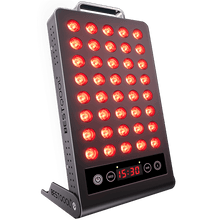
A panel matched to the treatment area usually beats buying the largest unit you can afford. If your main goal is post-lift recovery for quads, lower back, shoulders, and hamstrings, a medium or large panel is usually more practical than a handheld device because it covers more tissue with fewer position changes. If your main issue is a single elbow, wrist, or knee, a flexible pad or smaller targeted device may be easier to use correctly.
Most evidence-aware consumer guidance centers on wavelengths in the red and near-infrared ranges, commonly around 630 to 700 nm for red and roughly 800 to 850 nm or higher for near-infrared, with dual-wavelength devices often chosen for broader use cases, as summarized in red light therapy benefits and safety, how red and near-infrared light work, and at-home device tips. For a home gym recovery corner, that usually means a panel or wrap that includes both red and near-infrared is the most flexible choice.
Here is the main tradeoff most buyers need to see clearly:
Best fit in a home gym |
Main advantage |
Main limitation |
|
Small handheld or spot device |
One joint, one tendon, facial use |
Lower cost, easy storage |
Slow for full-body recovery |
Flexible pad or wrap |
Knees, elbows, lower back, shoulders |
Can contour to curved areas |
Limited total coverage |
Mid-size panel |
Most strength and recovery routines |
Good balance of coverage and space |
Needs a fixed standing lane |
Large panel |
Frequent front-and-back body sessions |
Fewer position changes |
Higher cost and larger footprint |
If you want one setup that serves both training recovery and general wellness, a mid-size panel is often the sweet spot. It gives you enough surface area for quads, back, hips, and shoulders without taking over the room.
Build a Session Flow You Will Actually Repeat

A consistent routine matters more than pushing longer sessions. Many home-use recommendations cluster around 10 to 20 minutes per treatment area, about three to five times per week, with users often advised to start closer to 5 to 10 minutes and build up, as reflected in at-home device tips, how red and near-infrared light work, and what home users should know. That is why the simplest recovery corner is usually the best one: you should be able to finish your workout, wipe off sweat, expose the target area, put on goggles, and start within two minutes.
The most useful pattern in a home gym is to assign the corner to a recovery moment you already have. After lower-body day, stand 6 to 12 inches from the panel for quads and calves. After upper-body day, turn for shoulders, upper back, and chest. On non-training days, use the same corner for a shorter relaxation or mobility session. If a panel covers only one side well, plan for front one day and back the next instead of forcing a complicated full-body routine every time.
The biphasic dose response is the key nuance here. More is not always better. Several sources note that too little light may do very little, but too much can reduce benefit or irritate the skin. That is one reason vague consumer instructions can be a problem: if the device does not clearly tell you distance, output, and timing, you are guessing at dose.
Make the Corner Safe, Clean, and Low-Friction
A generally safe, non-UV treatment is still not a free-for-all. Eye protection is a smart default when you are facing a panel, especially near the face, and overuse can lead to redness, swelling, or irritation. home-device safety and FDA clearance also notes that reported injuries with home devices tend to involve misuse, excessive duration, or faulty equipment, which is why clean wiring, stable mounting, and built-in timers matter in a gym environment where sweat and rushing are normal.
Bare skin helps light reach the target tissue more predictably, and several home-use guides advise avoiding heavy lotions, sunscreen, or makeup during sessions because they can block or scatter light, including Bestqool. In practice, that means the corner should sit close enough to your towel and mirror that you can quickly clean the area and expose it without turning recovery into another chore.
Device quality also deserves a sober view. An FDA-cleared device is mainly a safety signal, not proof that every marketing claim is effective. generally safe, non-UV treatment and what home users should know take a similarly cautious line: the therapy looks promising for some skin, pain, and musculoskeletal uses, but it is not a cure-all and is not equally well supported for every claim. For a recovery corner, that means buying for practical use and safety first, not hype.
What Results to Expect From a Home Gym Setup
A home device can be effective with consistent use, but it usually works on a slower, cumulative timeline than people want. how red and near-infrared light work notes that visible or symptomatic benefits often show up after about two to four weeks of steady use, while some at-home guides describe four to 12 weeks for deeper or more stubborn issues depending on the goal and device.
That timing is why progress tracking belongs inside the corner. Keep a small notebook or note on your cell phone for body area, minutes, distance, and how your soreness or stiffness feels the next morning. If your lower back feels looser after deadlift day, or your knees feel less cranky during the first five minutes of a warm-up, that is the kind of real-world signal worth tracking. If nothing changes after several weeks of correct use, it may be time to reassess the setup, the device, or whether the issue needs medical evaluation instead of more wellness tools.
The evidence remains mixed for some broader performance and pain claims, so the cleanest promise is this: a well-built recovery corner can support consistency, comfort, and a better recovery routine, but it should sit alongside sleep, nutrition, hydration, and smart programming, not replace them.
A good recovery corner feels almost boring in the best way. It is out of the traffic lane, easy to start, easy to repeat, and built around the body areas you actually need to recover. When the setup is this practical, red light therapy has the best chance to become a real part of your training week instead of another expensive gadget in the corner.


 Small
Small

 Moderate

 Moderate

 Moderate

 Full
Full

