

If your desk is too cramped for a red light therapy panel, move the treatment station instead of forcing the panel onto your workspace. The best solution is usually a small dedicated area with the right distance, angle, and routine, or a different device type for highly targeted goals.
Does your monitor already crowd your keyboard, coffee mug, and charger, leaving no safe place for one more piece of equipment? The good news is that red light therapy does not require a spa-like room, and a small, repeatable setup often makes it easier to stay consistent. This guide will help you decide whether to relocate the panel, change the mount, or switch to a more compact device.
Start With the Right Question
For most people, the real issue is not, “How do I squeeze a panel onto my desk?” but, “Where can I use it correctly and consistently?” In practice, a desk is often the worst place for a panel because treatment works best when the light reaches bare skin at the intended distance, not when the device is wedged behind a laptop or angled around a second monitor. Evidence reviews on dose, distance, and disclosed device specs show that red and near-infrared light therapy are highly parameter-dependent, so convenience matters only if the setup still lets you use the device as designed.
That matters because red light therapy is not just red-colored light. Home devices typically use visible red wavelengths for more superficial targets such as skin appearance and near-infrared wavelengths for deeper tissues such as muscles and joints, as described in consumer medical guidance. If your panel cannot sit at the right distance or face the target area directly, you may end up with a clumsy setup that is less effective than a smaller device used properly.
Why Your Desk Often Fails as a Treatment Station
A crowded desk creates three predictable problems. First, panels need clearance, ventilation, and a stable position. Second, many home routines call for roughly 5 to 20 minutes per area, often several times per week, so the setup has to be comfortable enough to repeat. Third, the distance from the panel to your body changes quickly when the device gets pushed behind a screen, elevated on books, or parked off to one side. Guidance on home-use timing and distance also notes that results depend on repeated, long-term use, which means an awkward station usually becomes an abandoned station.
Coverage is another issue. If your goal is facial skin support, a very small space may be manageable. If your goal is neck tension, shoulder recovery, low-back soreness, or another larger treatment area, a tiny patch of desk space works against you. Stanford’s overview of the evidence makes an important point here: device power, wavelength, duration, and frequency all vary, and home devices are not interchangeable. That is why forcing a large panel into a bad position is usually worse than choosing a different format.
The Best Fix Is Usually a Separate Mini Station

If you already own a panel, the most practical answer is to stop treating it like desk decor. A narrow therapy corner beside the desk, near a wall outlet, usually works better than the desktop itself. You need only enough room to stand or sit at the manufacturer’s recommended distance, keep the panel stable, and expose the target area without twisting around office furniture. Home-use guidance on matching the setup to the treatment area supports this approach because correct positioning and repeatability matter more than keeping the device within arm’s reach while you answer emails.
A simple example makes this clearer. If your panel is meant to be used from about 6 to 18 inches away and your desk is 30 inches deep, your monitor stand, keyboard, and seated posture can easily push your body outside the ideal range. By contrast, a slim stand next to the desk, or a cleared corner with a chair facing the panel, lets you sit upright and keep your face, neck, knee, or shoulder aligned without guessing.
A wall mount can work, but only if it keeps the panel at a useful height and distance. A door hook, narrow rolling cart, or freestanding stand is often better in apartments and home offices because it preserves flexibility. That tradeoff is practical: wall mounting saves floor space, while a cart or stand is easier to reposition for face, chest, or leg sessions. The installation guidance for home panel placement reinforces the basics of stability, ventilation, and keeping the treatment area unobstructed.
When You Should Switch Device Types Instead
Sometimes the honest answer is that a panel is the wrong device for your space. If your goal is very localized, such as jawline skin care, a single knee, a wrist, or a patch of scalp, a smaller form factor may be more realistic than reorganizing your office. Clinical and consumer overviews of different device formats note that masks, caps, wands, and other compact tools exist precisely because not every use case needs a panel.
That does not automatically make smaller devices better. The tradeoff is coverage. A panel is efficient for larger areas, while a compact device may be easier to store but slower for broader use. For someone treating occasional neck tightness after computer work, a wrap or compact targeted device may be easier to use consistently than a mid-size panel that never leaves the closet. For someone hoping to cover the face, chest, and shoulders in one session, the panel usually remains the more practical tool if you can give it a separate station.
Device format |
Best when space is tight |
Main advantage |
Main drawback |
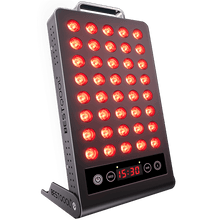
Small panel |
You can clear a corner beside the desk |
Covers more area at once |
Still needs stand space and correct distance |
You want to treat one joint or muscle area |
Easy storage and targeted use |
Less efficient for the face or larger body areas |
|
You need something portable for spot treatment |
Minimal footprint |
Small coverage area and a longer overall routine |
|
Your goal is face or scalp only |
Purpose-built for one area |
Not versatile for body recovery |
How to Choose a Space-Smart Device Without Falling for Marketing
The safest way to shop is to ignore lifestyle claims and focus on disclosed specifications, clearance status, and fit for your actual use case. A science review on what to look for in red light therapy products recommends devices that clearly state wavelength, irradiance, session guidance, and regulatory status because many consumer products are marketed far more aggressively than they are validated.
For desk-adjacent use, that usually means choosing a device that matches your treatment area instead of chasing the biggest panel you can afford. If you only want help with facial skin appearance, a smaller facial device may be enough. If your main goal is post-workout muscle recovery or joint comfort, deeper-penetrating near-infrared capability may matter more than a cosmetic-focused design, as summarized in evidence-aware consumer guidance. This is also where FDA-cleared labeling can be useful, even though clearance is mainly about safety and not a guarantee of dramatic results.
Be careful with expectations. The best-supported uses are narrower than social media suggests. Stanford’s review of current evidence points to stronger support for wrinkle reduction and hair regrowth than for broad claims about sleep, athletic performance, or general wellness. If a tiny device promises full-body transformation from your desktop, that is a reason to slow down.
Make the Routine Easy Enough to Repeat
Once the hardware fits the room, the next job is reducing friction. Red light therapy tends to work more like exercise than like pain-relief cream: the benefits usually come from steady use rather than one heroic session. Harvard’s overview of home devices notes that improvement often takes multiple sessions per week over months, and Brown Health’s safety guidance similarly emphasizes repeated use over weeks or months.
That means the best setup is the one you will actually use. Keep the panel or compact device where setup takes less than a minute. Store eye protection with it if your device calls for that. Use it before your shower, after your workout, or during a fixed part of your evening wind-down rather than trying to multitask through it at your desk. A short, repeatable 10-minute routine in a quiet corner is more useful than a perfect plan that never happens.
Safety, Comfort, and Realistic Expectations
Red light therapy is generally considered low risk when used as directed, but low risk is not the same as no risk. Short-term side effects can include irritation, redness, eye strain, or discomfort, and bright light exposure can feel overstimulating for some people. General light-therapy guidance on monitoring early side effects and red light guidance from Cleveland Clinic both support a common-sense approach: increase distance, reduce session length, and stop forcing the routine if your body is telling you the setup is not comfortable.
It is also worth keeping one evidence-based boundary in mind. Red light therapy is not a substitute for bright-light therapy for seasonal mood issues, and it is not a cure-all. The strongest consumer medical sources here consistently describe it as a supportive tool, not a replacement for diagnosis, core skin care, exercise, recovery basics, or medical treatment when those are needed.
If your desk has no room for a panel, treat that as useful feedback rather than a failure. Build a small treatment station that respects distance and comfort, or switch to a more targeted device that fits your real life. The setup that wins is the one that is safe, repeatable, and suited to the area you actually want to treat.


 Small
Small

 Moderate

 Moderate

 Moderate

 Full
Full

