

Use red light therapy to support workouts, not replace good training and recovery habits. For most home exercisers, short, consistent sessions before training for muscle readiness or after training for soreness make the most sense.
Do your legs feel heavy before intervals, or do you finish a hard cardio session already dreading the next morning’s stiffness? The most useful evidence points to better recovery, less next-day soreness, and more consistent training when red light therapy is paired with smart timing and realistic expectations. You can fit it into HIIT or cardio days without overdoing it or wasting time.
Why red light therapy fits a home workout routine
Specific red and near-infrared wavelengths may influence cellular activity without heavy heat or impact. In practical terms, that matters for home HIIT and cardio because these workouts often create a recovery bottleneck: your lungs may feel ready again before your calves, quads, hips, or low back do.
The proposed mechanism is photobiomodulation. Light energy is absorbed in tissue, especially around mitochondrial pathways, which may support ATP production, circulation, and inflammatory balance. The practical takeaway is simpler: when a home routine is limited by soreness and tissue fatigue, red light therapy may help you recover with less friction.
Where people get misled is performance hype. Selective benefits such as skin-related outcomes have stronger support than sweeping athletic claims. That matches the broader sports-recovery literature, which shows promising findings for soreness, fatigue resistance, and some muscle-damage markers, but also mixed results depending on timing, wavelength, muscle group, and exercise test.
What it can realistically do for HIIT and cardio
For home exercisers, the most believable upside is not instant stamina but better repeatability. Research on muscle recovery suggests red and near-infrared light may support recovery-related outcomes. If your Tuesday sprint session usually ruins Wednesday stairs, that is the kind of problem red light therapy is better suited to than chasing dramatic cardio gains.
The second likely benefit is easier training adherence. Consistent home use in the 3 to 5 sessions per week range is commonly suggested, with noticeable changes often building over several weeks rather than after one workout. In practice, the people who get the most value are usually the ones already doing the basics reasonably well: hydration, enough protein, cooldowns, and sleep.
The limitation is just as important. At-home devices are generally less powerful than clinic devices. If your training plan, sleep, or fueling is chaotic, red light therapy will not reliably compensate for that.
When to use it: before, after, or both
The best timing depends on your actual problem. If your main issue is stiffness before fast intervals, shorter pre-workout sessions make sense. If your main issue is soreness that lingers into the next session, post-workout use is usually the better fit.
Before a HIIT workout
Pre-exercise photobiomodulation has some of the stronger support, especially as a preconditioning strategy. A practical home version is 5 to 10 minutes on the muscle groups you are about to stress, such as quads, hamstrings, glutes, or calves before treadmill sprints, bike intervals, or jump-rope circuits.
A simple example looks like this: if your HIIT block starts at 7:00 AM, spend about 6:45 to 6:55 AM in front of the panel with bare skin exposed over the legs, then do your normal dynamic warm-up. Red light therapy should not replace the warm-up; it should make the warm-up feel smoother.
After a cardio or interval session
Post-workout use is often most practical in short sessions, especially when it fits naturally with your cooldown, stretching, shower, and rehydration.
A useful example is a 25-minute incline treadmill interval session that leaves your calves and hip flexors tight. After cooling down, you could do 10 minutes on the calves and 10 minutes on the front of the hips or quads. If that feels too long to sustain, reduce the area treated rather than stretching the habit into something you will quit in a week.
Using both on the same day
Some sports-focused sources support using it both before and after exercise, but that does not automatically mean more is better. Dose response matters, and too little may do very little. For most home users, one session tied to the biggest pain point is the more sustainable starting point.
A simple home routine that actually fits real life

The easiest way to think about it is to match the light session to the workout stress and the tissue you want to support. If you do HIIT three times a week and steady-state cardio twice a week, you do not need five long full-body sessions.
Workout day |
Best use case |
Practical red light approach |
HIIT day with stiff legs |
Better readiness |
5 to 10 minutes before training on quads, hamstrings, and calves |
HIIT day with hard impact or sprinting |
Better recovery |
10 to 15 minutes after training on the muscles that took the load |
Moderate cardio day |
Light recovery support |
Short post-workout session if you are accumulating soreness |
Rest or active recovery day |
Spot treatment |
10 minutes on the areas still tight from the last hard workout |
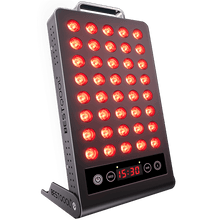
That can stay manageable. If you own a mid-size panel and treat both legs for 10 minutes after three weekly HIIT sessions, that is about 30 minutes a week total if both legs are covered at once. For most people, that is realistic enough to maintain.
How to set up the device correctly at home
Home-use guidance usually centers on bare skin and a consistent treatment distance. Near-infrared light is generally the more relevant mode for deeper muscle and joint targets, while red light tends to be more superficial.
The most common mistake is poor dosing through bad positioning. Stand too far away and you may turn a decent device into an underpowered one. Stay too long because you think longer must be better, and you may not gain anything extra. The pattern that works best in home setups is boring but effective: the same distance, the same body area, and the same timing, repeated for several weeks so you can judge whether it is helping.
Device quality matters too. FDA-cleared products and studied wavelength ranges are better signs of credibility than vague marketing claims. If the brand is vague about wavelengths, power, treatment distance, or instructions, that is a warning sign.
Safety, pros, and limits
Short-term use appears generally safe when used as directed. Even so, eye protection is sensible when you are facing a bright panel directly, and extra caution is warranted if you take medications that increase light sensitivity.
The main appeal is straightforward: it is low effort, noninvasive, home-friendly, and easy to combine with existing recovery habits. The downsides are cost, time, uneven device quality, and the fact that results are usually gradual. Meaningful changes are often described as cumulative over several weeks.
It is also not the right tool for every problem. Red light therapy is not expected to fix every training issue. If your knee pain worsens every run, or your resting fatigue keeps climbing, the answer is not just more light.
The best way to tell if it is working
Keep the test simple. Use the same setup for three to four weeks and track only a few things: how sore you are the next morning, whether your warm-up feels easier, and whether you can keep your planned workout frequency without backing off. That kind of tracking is more useful than trying to guess from one session.
If there is no clear difference after a consistent trial, the issue may be the device, the dose, the timing, or the fact that red light therapy is not your limiting factor. In many home routines, sleep debt and underfueling are still the bigger recovery problem.
Build it around consistency, not hype. A short, repeatable session before or after the workouts that beat you up the most is usually the smartest place to start, and if it helps you recover well enough to train steadily, that is the win that matters.


 Small
Small

 Moderate

 Moderate

 Moderate

 Full
Full

