

If your outlet is too far from the bed, the safest fix is usually to move the treatment spot closer to the power source, choose a more portable device, or use the device only at the exact position and distance the manufacturer recommends.
Are you staring at your panel or mask at bedtime, realizing the cord barely reaches and the whole routine already feels annoying? Home red light therapy works best when the setup is easy to repeat and the light is used at the right distance for the right amount of time. The simplest answer is usually to move the setup, change the device, or adjust the routine without turning your bedroom into a hassle.
Why outlet distance matters more than it seems
For home red light therapy, wavelength, intensity, and duration all affect results, so a setup that changes your distance from the device can change the dose you actually get. That matters because many home protocols are built around a specific placement, not just having the light on somewhere in the room.
A second issue is consistency. At-home devices are generally less powerful than clinic devices, so regular use usually matters more than occasional marathon sessions. If your outlet location makes every session awkward, you are much more likely to skip days, shorten sessions, or use the device from the wrong angle just because it is easier.
That is also why more is not always better. The dose-response pattern can become counterproductive when sessions are excessive, so trying to compensate for a poor setup by sitting longer or improvising the distance is not a smart workaround.
Start by matching the device to your real bedroom layout
If your bed is the only place you want to use the device, the format matters as much as the brand. Panels, masks, handhelds, and body-targeted devices serve different use cases, and the wrong format is often the real reason the outlet feels too far away.
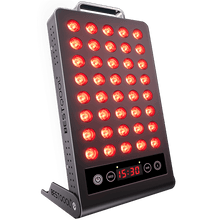
A full panel makes sense when you want broader coverage or deeper tissue support, especially when near-infrared light is part of the goal. Red light in the 630 to 660 nm range is typically used for surface-level skin goals, while near-infrared in the 810 to 850 nm range is more relevant for deeper tissues such as muscles and joints. But panels usually need a fixed position and a known treatment distance, so they are not the easiest choice for a cramped bedroom.
If your main goal is facial skin support, a mask is often the cleaner answer because it removes much of the distance problem. If your goal is a shoulder, knee, lower back, or another single area, a pad or handheld unit can be much easier to use in bed than a large panel. In plain terms, if the outlet is the obstacle, reducing the size and positional demands of the device is often the most practical fix.
The best solutions when the outlet is too far from the bed

The most reliable solution is to move the treatment location, not guess your way around the cord. A small chair, bench, or bedside seat closer to the wall outlet often works better than trying to use a panel while lying down. If your manufacturer recommends a panel distance of about 6 to 12 inches and session lengths of about 10 to 20 minutes, those details are part of the dosing plan, not decoration. If the cord leaves you sitting 4 feet away, you no longer have the same treatment setup.
A second good fix is to move the furniture instead of the device. Shifting the bed or nightstand enough to create a clear treatment lane can solve the problem without changing your routine. This is especially useful if you already own a panel and like it. The benefit is that you preserve the intended distance and angle; the downside is that the bedroom layout may become less comfortable for sleeping or walking.
A third option is to reserve red light therapy for a different room entirely. That may sound less convenient, but it often becomes more sustainable. A stable setup in a guest room, home office, or corner of the living room is usually better than a bedtime-only setup that never quite works. Since consistent use over weeks and months matters more than one-off sessions, the best location is the one you will actually use correctly.
When a portable device is the smarter purchase
If you have not bought a device yet, outlet distance should affect the purchase. Home devices are safer and more practical when used correctly, but practicality also means thinking about how the device fits into your space.
A portable mask is often the easiest fit for skin-focused users because you are not trying to keep your face at an exact distance from a wall-mounted panel. A handheld can work well for small areas, though sessions may take longer if you are treating multiple spots. A wrap or pad is often simpler for recovery-focused use because it targets the area directly instead of forcing you to position your body around a light source.
Here is the tradeoff in a simple bedroom context:
Setup choice |
Best part |
Main limitation |
Full panel near wall outlet |
Broad coverage and stronger whole-area treatment |
Needs space, positioning, and strict distance control |
Face mask in bed |
Easy routine and minimal distance issues |
Mostly limited to facial goals |
Good for one small area and flexible positioning |
Less efficient for large-body coverage |
|
Most repeatable and easiest to keep correct |
Not a true in-bed routine |
Be careful with convenience fixes
The biggest mistake is letting convenience override the instructions. Consumer devices may be safe when used as directed, but as directed is the key phrase. If you are considering an extension cord, power strip, or any add-on, the device manual should be the deciding document because the power setup, placement, and heat behavior can differ across products.
The same caution applies to your eyes. Eye protection is recommended, and several expert sources warn against staring directly into LEDs. If moving the setup creates a new angle where the light is more directly in your line of sight, fix that before you change anything else.
Keep expectations realistic while making the setup easier
The evidence for red light therapy is real but limited. The strongest support today is for some skin uses, while broader claims about pain, sleep, athletic performance, or general wellness are much less settled. That does not mean home use is pointless. It means your bedroom setup should match a clear goal, not a vague hope that any red light anywhere will help.
For example, if you want facial skin support before bed, a mask may be the most sensible answer. If you want muscle or joint recovery and only own a panel, a dedicated chair near the outlet may be the better move. If you mostly want a relaxing nightly ritual, choosing a smaller device you will actually use may matter more than switching rooms.
A workable red light setup is one that lets you stay close enough, consistent enough, and careful enough to follow the real protocol instead of improvising around the cord. If the outlet is too far away, simplify the routine before you try to make it longer.


 Small
Small

 Moderate

 Moderate

 Moderate

 Full
Full

